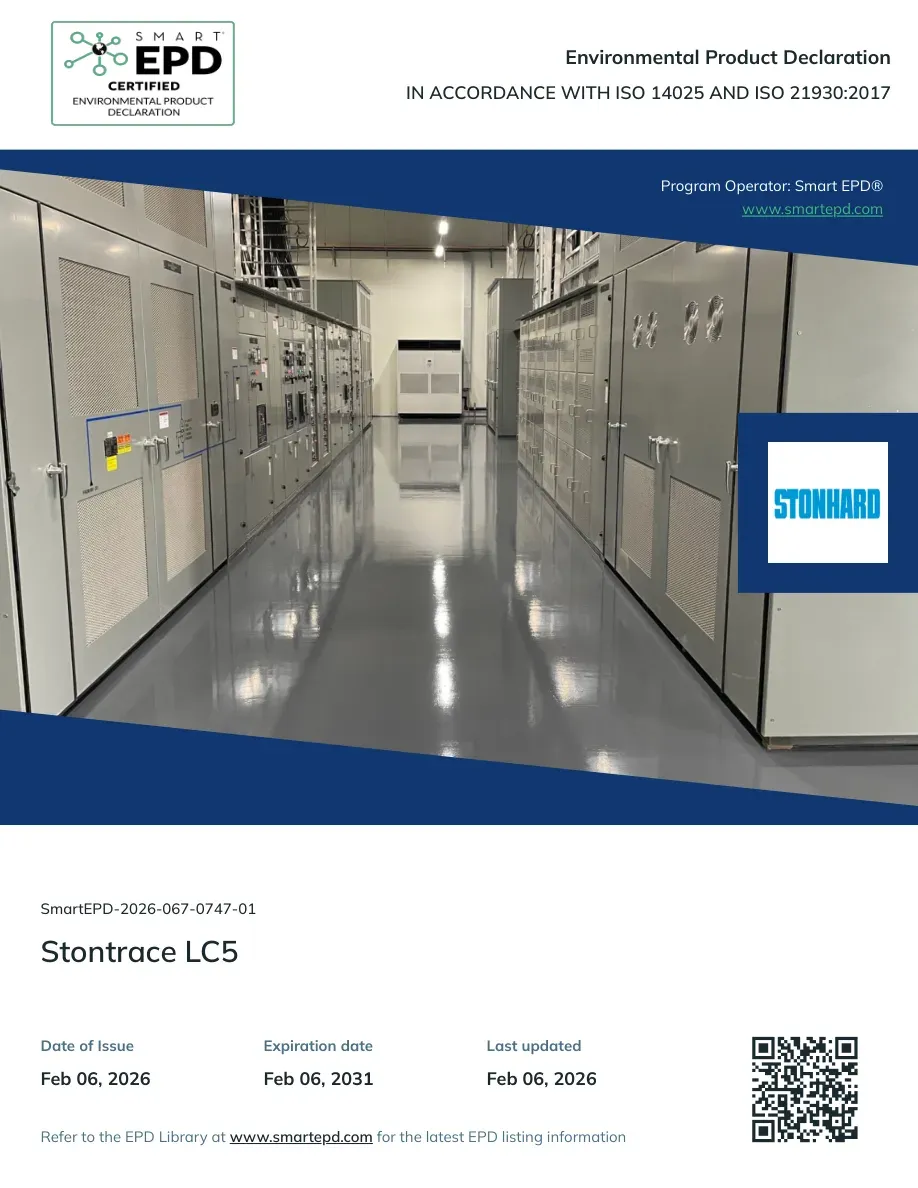
Program Operator: Smart EPD®www.smartepd.comEnvironmental Product DeclarationIN ACCORDANCE WITH ISO 14025 AND ISO 21930:2017SmartEPD-2026-067-0747-2.1Date of IssueApr 28, 2026Expiration dateApr 28, 2031Last updatedApr 28, 2026Refer to the EPD Library at www.smartepd.com for the latest EPD listing informationStontrace LC5
General InformationStonhard1000 E. Park Ave., Maple Shade, NJ 080521-800-257-7953ctrageser@stonhard.comstonhard.comProduct Name:Stontrace LC5Functional Unit:1 m2 of covered and protected flooring surface for a period of 60 yearsDeclaration Number:SmartEPD-2026-067-0747-2.1Date of Issue:April 28, 2026Expiration:April 28, 2031Last updated:April 28, 2026EPD Scope:Cradle to graveA1 - A3, A4, A5, B1 - B7, C1 - C4, DMarket(s) of Applicability:North AmericaGeneral Organization InformationStonhard is the unprecedented leader in manufacturing and installing high performance floors. Our seamless, long lasting, easy to clean systems are engineered for both industrial and commercial markets. We also bring the same performance to our wall and lining systems. Joining form and function, our floors are the dependable go-to choice for tough manufacturing environments, while still honoring innovative design for commercial environments. Epoxy, urethane and fast-track methyl methacrylate resin-based systems deliver a broad range of options for every market and application. Stonhard manufactures and installs products throughout the world with headquarters in Maple Shade, New Jersey. Stonhard is an ISO-9001 registered company.Further information can be found at:https://www.stonhard.com/Limitations, Liability and OwnershipEnvironmental declarations from different programs (ISO 14025) may not be comparable. Comparison of the environmental performance of products usingEPD information shall be based on the product’s use and impacts at the building level, and therefore EPDs may not be used for comparability purposes whennot considering the whole building life cycle. EPD comparability is only possible when all stages of a life cycle have been considered. However, variations anddeviations are possible. Example of variations: Different LCA software and background LCI datasets may lead to differences results for upstream ordownstream of the life cycle stages declared. The EPD owner has sole ownership, liability, and responsibility for the EPD.Reference StandardsStandard(s):ISO 14025 and ISO 21930:2017PCR:NSF PCR for Resinous Floor CoatingsStontrace LC5StonhardPage 2 / 19
Date of issue: December 17, 2018Valid until: June 30, 2026PCR review panel:Contact Smart EPD for more information.General Program Instructions:Smart EPD General Program Instructions v.2.0, March 2025Verification InformationLCA Author/Creator:Samuel Fafelsamuel@parqhq.comEPD Program Operator:Smart EPDinfo@smartepd.comwww.smartepd.com585 Grove St., Ste. 145, Herndon, VA 20170, USAVerification:Independent critical review of the LCA and data, according to ISO 14044 andISO 14071:ExternalRifat KarimIndependent Consultantrifat.chimique@gmail.comIndependent external verification of EPD, according to ISO 14025 andreference PCR(s):ExternalRifat KarimIndependent Consultantrifat.chimique@gmail.comProduct InformationFunctional Unit:1 m2 of covered and protected flooring surface for a period of 60 yearsMass:0.8092 kgReference Service Life:10 YearsProduct Specificity:Product AverageProduct SpecificProduct DescriptionStontrace LC5 is a high-performance resin floor coating system designed to add a durable, protective layer over prepared concrete or existing resinous floors.Used as a standalone coating or in conjunction with Stonhard flooring systems, it helps enhance floor durability and appearance while improving cleanabilityand maintenance. Stontrace LC5 is supplied as a system with coordinated coating components (including a pigmented primer/topcoat material and aseparate topcoat), enabling a robust finished surface suited for demanding industrial and commercial environments where added abrasion and chemicalresistance are needed.Further information can be found at:https://www.stonhard.com/products/complementary/floor-coatings/Product SpecificationsProduct Classification Codes:EC3 - Finishes -> Flooring -> OtherFlooringStontrace LC5StonhardPage 3 / 19
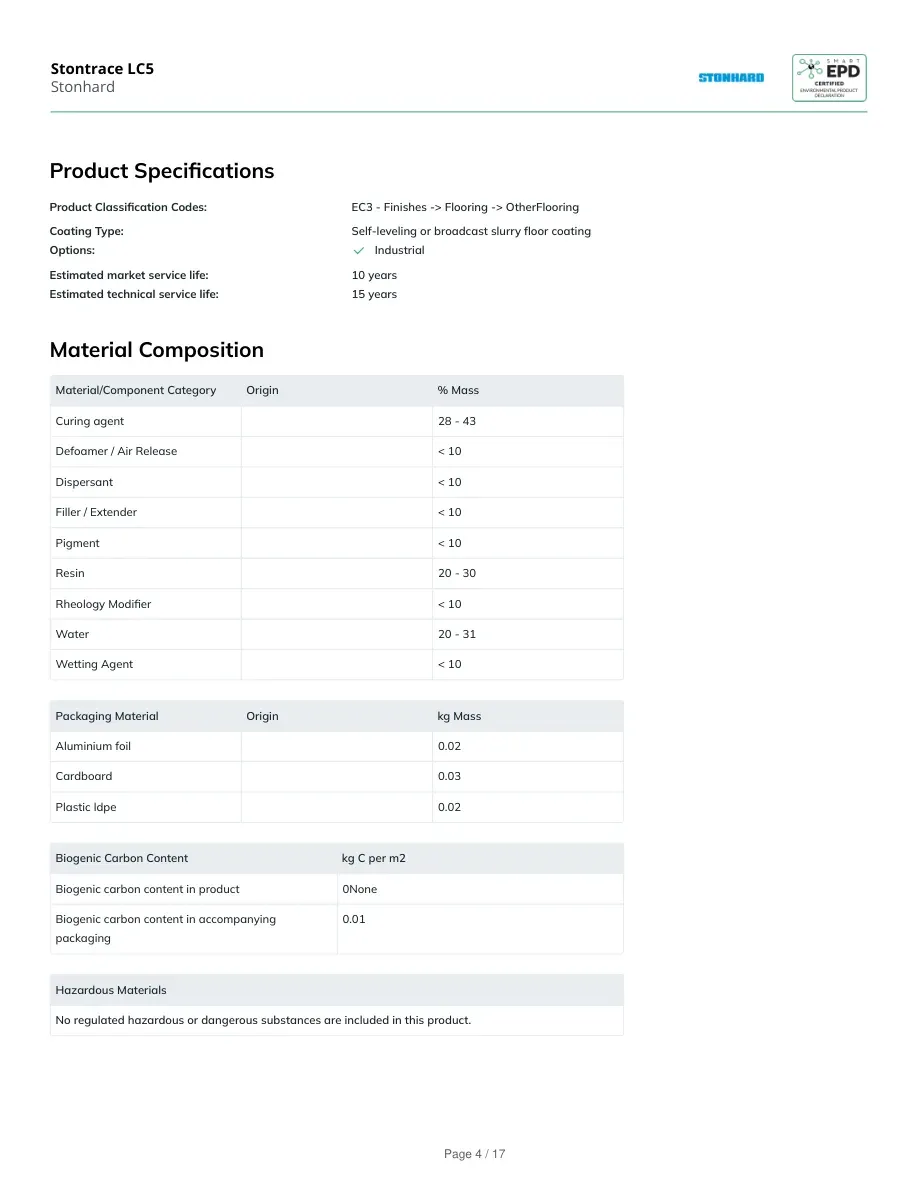
Coating Type:Self-leveling or broadcast slurry floor coatingOptions:IndustrialEstimated market service life:10 yearsEstimated technical service life:15 yearsMaterial CompositionMaterial/Component CategoryOrigin% MassCuring agent28 - 43Defoamer / Air Release< 10Dispersant< 10Filler / Extender< 10Pigment< 10Resin20 - 30Rheology Modifier< 10Water20 - 31Wetting Agent< 10Packaging MaterialOriginkg MassPlastic hdpe0.09Steel generic0.07Biogenic Carbon Contentkg C per m2Biogenic carbon content in product0NoneBiogenic carbon content in accompanyingpackaging0.01Hazardous MaterialsNo regulated hazardous or dangerous substances are included in this product.EPD Data SpecificityPrimary Data Year:2023-2024Manufacturing Specificity:Industry AverageManufacturer AverageFacility SpecificStontrace LC5StonhardPage 4 / 19
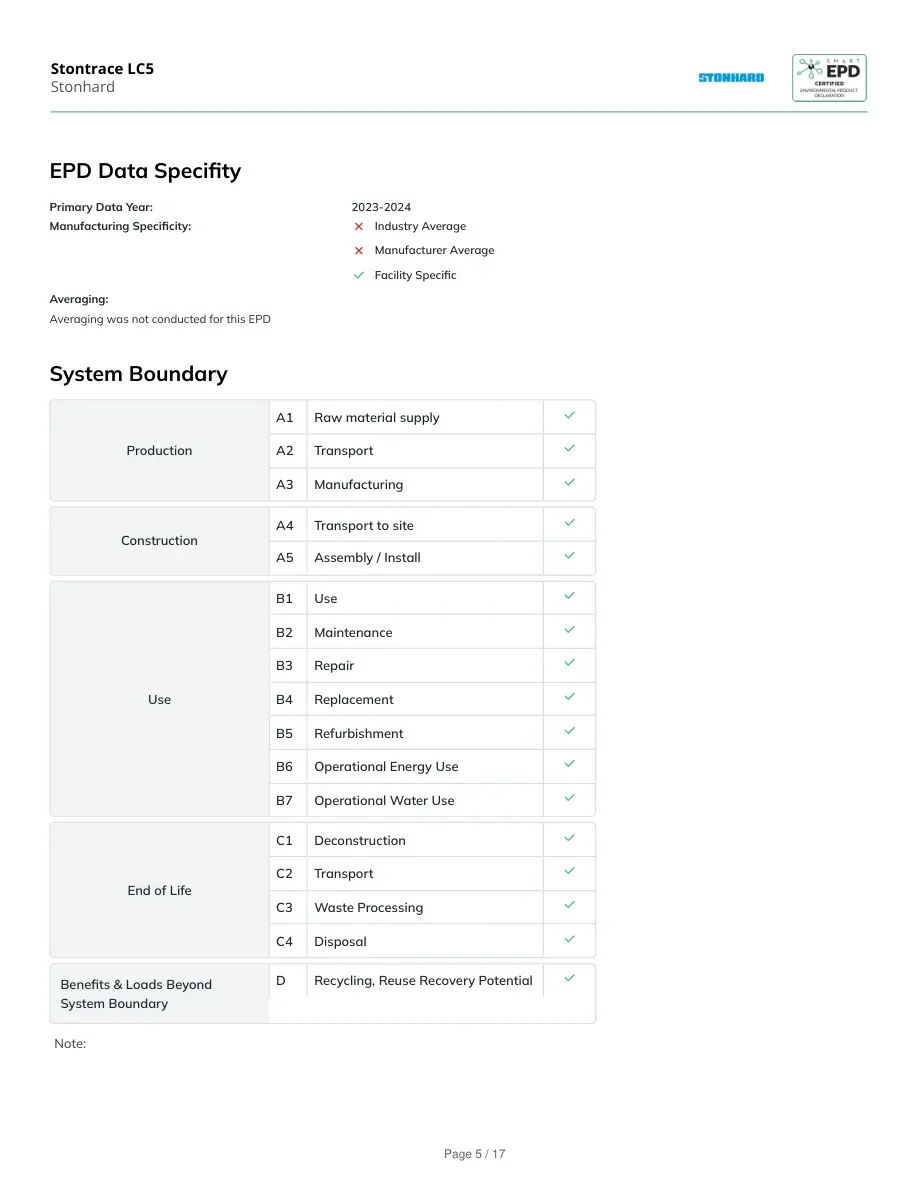
Averaging:Averaging was not conducted for this EPDSystem BoundaryProductionA1Raw material supplyA2TransportA3ManufacturingConstructionA4Transport to siteA5Assembly / InstallUseB1UseB2MaintenanceB3RepairB4ReplacementB5RefurbishmentB6Operational Energy UseB7Operational Water UseEnd of LifeC1DeconstructionC2TransportC3Waste ProcessingC4DisposalBenefits & Loads BeyondSystem BoundaryDRecycling, Reuse Recovery PotentialNote:ND = Module not declaredPlantsCherry Hill, NJCherry Hill, NJ, United States of AmericaStontrace LC5StonhardPage 5 / 19
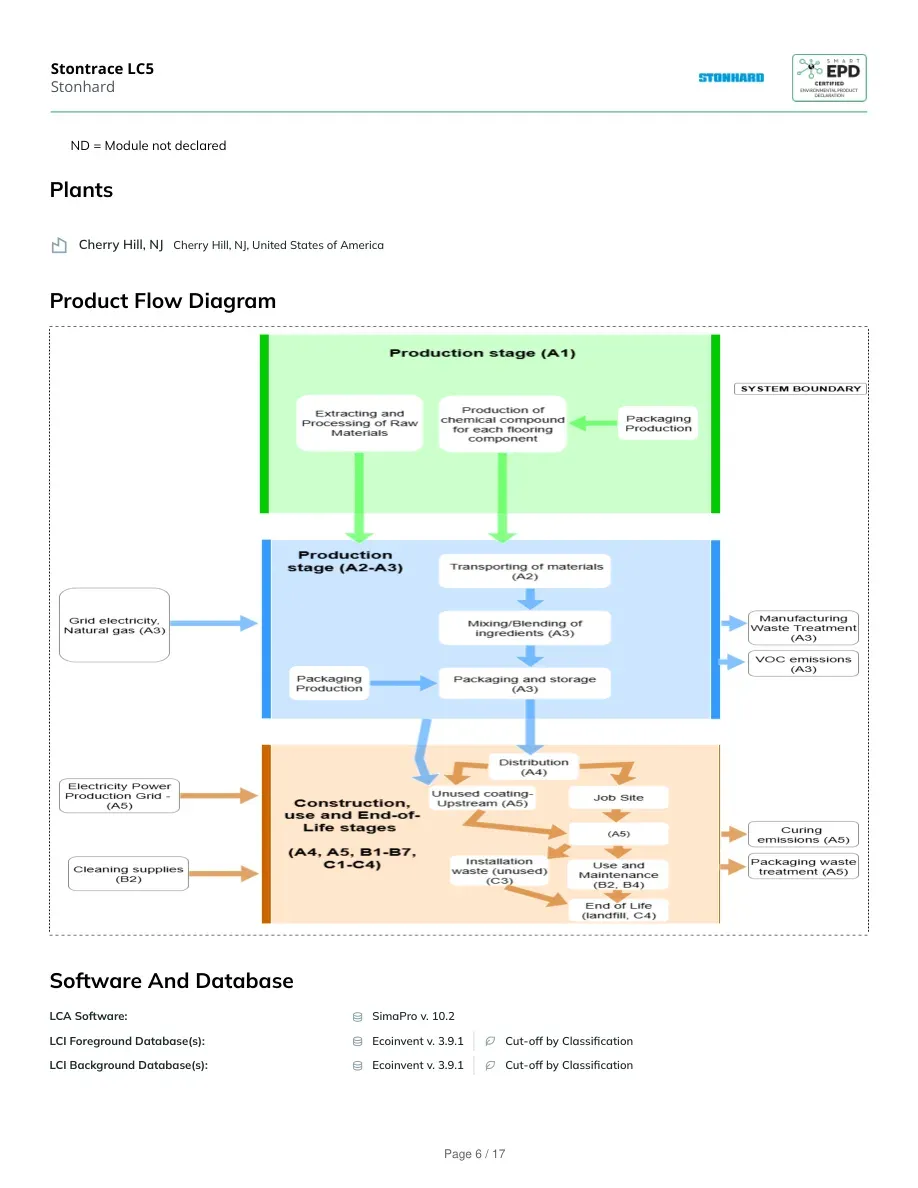
Product Flow DiagramSoftware And DatabaseLCA Software:SimaPro v. 10.2LCI Foreground Database(s):Ecoinvent v. 3.9.1Cut-off by ClassificationLCI Background Database(s):Ecoinvent v. 3.9.1Cut-off by ClassificationA foreground LCI database is the database used to model the primary, site-specific data collected for this EPD. A background LCI database is the databaseused to model generic or non-specific data.Data QualityThe quality of inventory data is evaluated based on several criteria, including precision, completeness, consistency, and representativeness.Stontrace LC5StonhardPage 6 / 19
Precision and completeness:Precision: The inventory data used in this study were either directly measured, calculated, or estimated based on primary data sources, ensuring highprecision. Background data from ecoinvent v3 database also has documented precision to the extent available.Completeness: The product system's mass balance and inventory completeness were thoroughly checked. Some exclusions were made in line with thePCR requirements, such as personnel impacts, R&D activities, business travel, secondary packaging, point of sale infrastructure, and the coatingapplicator. However, no data was intentionally omitted.Consistency and reproducibility:Consistency: Primary data were collected with a similar level of detail, while background data primarily came from the ecoinvent database, with otherdatabases used only if necessary or more representative. The modeling approach and other methodological choices were applied consistentlythroughout the model.Reproducibility: This study ensures reproducibility by providing comprehensive disclosure of input-output data, dataset choices, and modelingapproaches. A knowledgeable third party should be able to approximate the results using the same data and modeling methods.Representativeness:Temporal: Primary data were collected for a 12 month period starting on June 2023 and ending on May 2024 to ensure the representativeness of post-consumer content. Secondary data from the ecoinvent v3 database is typically representative of recent years.Geographical: Primary data represent Stonhard's production facility in Cherry Hill, NJ, US. The use of country-specific data ensures high geographicalrepresentativeness, and proxy data were only used when country-specific data were unavailable..Technological: Both primary and secondary data were tailored to the specific technologies studied, ensuring high technological representativeness.Life Cycle Module DescriptionPrimary data were collected for a 12-month period from June 2023 and ending on May 2024 to ensure technical, geographical, and temporalrepresentativeness. The manufacturing process starts with the reception of raw materials, typically in the form of chemical packages (cans, supersacks,bags, pails, among others). Next, the raw materials are mixed to forms resins and additives. After this step, the products are packaged and distributed tovarious distribution centers. Non-hazardous waste, consisting mainly of packaging waste materials, is sent for disposal, incineration, and/or recycling.Hazardous waste consisting of manufacturing & product losses and their disposal are modeled according to the PCR descriptions (solvent-based coatingsare incinerated for energy recovery and water-based coatings are sent to landfill)LCA DiscussionAllocation ProcedureAllocation of co-products was avoided, to the extent it was possible, based on the guidance given in ISO 14044:2006, and in ISO 21930:2017. Energy useand VOC emissions at the Cherry Hill, NJ factory were allocated by mass. Overhead burdens (building heating and corporate use consumption) wereexcluded using a square footage factor, that benchmarked and validated with process engineering models of resinous floor coatings production. The processdoes not consume process water or generate wastewater. Solid waste was estimated using packaging masses and material losses and allocated followingthe polluter pays principle.Cut-off ProcedureThe system boundary was defined based on relevance to the goal of the study. For the raw material (A1) and process related inputs (A3), all availableenergy and material flow data have been included in the model. Exclusions allowed by the PCR such as secondary and tertiary packaging, wereStontrace LC5StonhardPage 7 / 19
implemented, as well as overhead burdens such as building heating and corporate office consumption.Renewable ElectricityEnergy Attribute Certificates (EACs) such asRenewable Energy Certificates (RECs) or PowerPurchase Agreements (PPAs) are included in thebaseline reported results:NoScenariosTransport to the building/construction site (A4)A4 ModuleFuel Type:DieselVehicle Type:Truck and TrailerTransport Distance:1838 kmCapacity Utilization:33 %Packaging Mass:0.1647 kgWeight of products transported:0.9739 kgCapacity utilization volume factor:1Assumptions for scenario development:Transport distance includes finished product to distribution center and distribution center to pointof sale.Installation in to the building/construction site (A5)A5 ModuleInstallation Scrap Rate Assumed:2 %Product Lost per Declared/Functional Unit:0.01618 kgMass of Packaging Waste Specified by Type:0.1647 kgAssumptions for scenario development:Impacts from 2% of unused product and packaging waste disposalUse (B1)B1 ModuleDeclared Product Properties:The use stage begins after the resinous floor coating has fully cured; therefore, there are no significant impacts from the use of the installed product.Maintenance (B2)B2 ModuleMaintenance Cycle:36.67 Cycles/RSL220 Cycles/ESLStontrace LC5StonhardPage 8 / 19
Net Fresh Water Consumption Specified by WaterSource and Fate:0.83 m3Ancillary Materials Specified by Type:1.32 kgFurther assumptions for scenario development:As per the PCR, "220 cleaning events shall be reported in module B2 of the LCA and subsequentEPD." The cleaning solution contains 2.5% of a nonionic surfactant.Repair (B3)B3 ModuleFurther assumptions for scenario development:No repair impacts assumed as per PCR guidanceReplacement (B4)B4 ModuleReference Service Life:10 YearsReplacement Cycle:5 (ESL/RSL)-1Replacement of Worn Parts:4.05 kgFurther assumptions for scenario development:Values represent market service life scenarioRefurbishment (B5)B5 ModuleFurther assumptions for scenario development:No refurbishment impacts assumed as per PCR guidanceOperational Energy Use (B6) & Operational Water Use (B7)B6 & B7 ModulesFurther assumptions for scenario development:No operational energy and water use as per PCR guidanceEnd of Life (C1 - C4)C1 - C4 ModulesCollection ProcessCollected with Mixed Construction Waste:4.85568552 kgRecoveryLandfill:4.85568552 kgAssumptions for scenario development:Product landfilled at the end of lifeReuse, Recovery and / or Recycling Potentials & Relevant Scenario Information (D)D ModuleRecycling Rate of Product:0 %Recycled Content of Product:0 %Stontrace LC5StonhardPage 9 / 19
Net Energy Benefit from Energy Recovery fromWaste Treatment Declared as Export Energy inC3:0 MJNet Energy Benefit from Thermal Energy Due toTreatment of Waste Declared as Exported Energyin C4:0 MJNet Energy Benefit from Material Flow Declared inC3 for Energy Recovery:0 MJFurther assumptions for scenario development:Impacts limited to recycling of packaging materialStontrace LC5StonhardPage 10 / 19
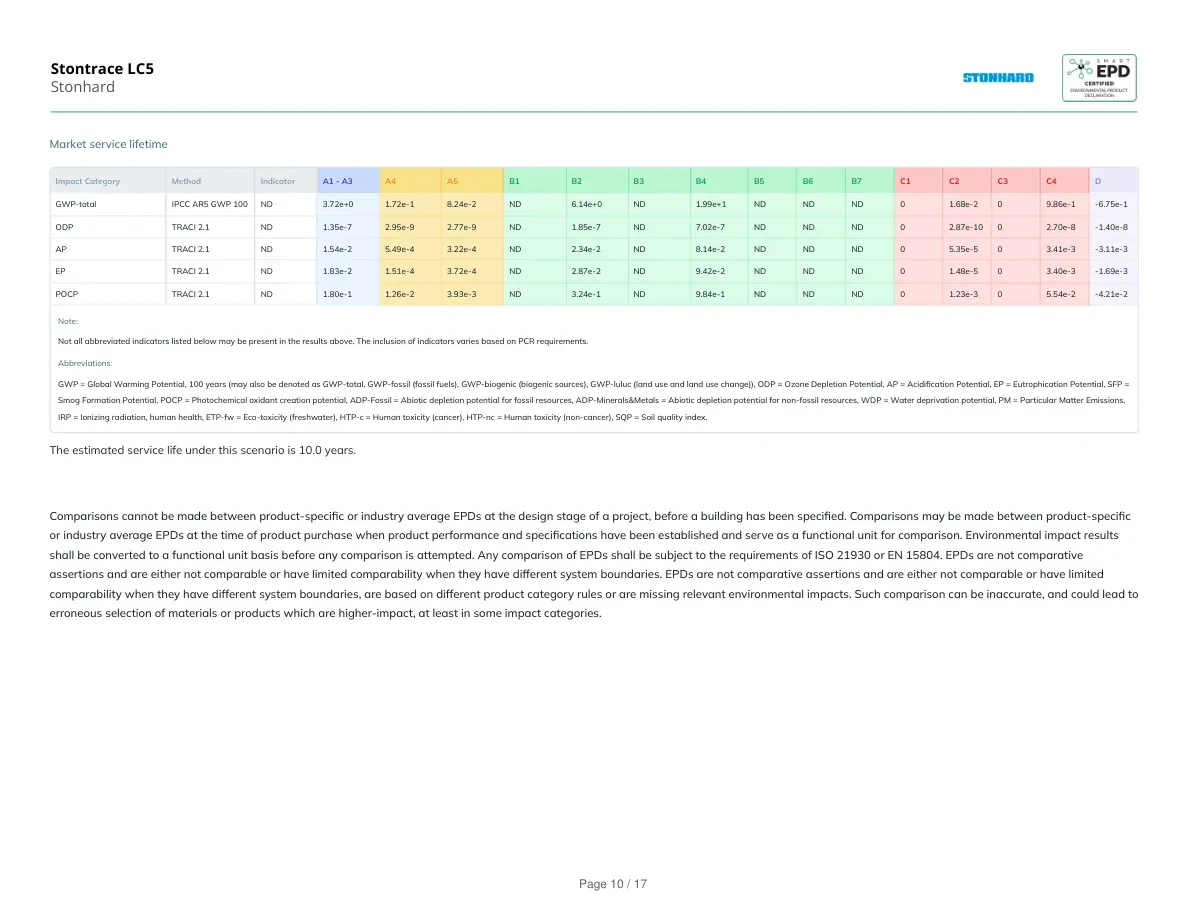
ResultsEnvironmental Impact Assessment ResultsIPCC AR5 GWP 100, TRACI 2.1per 1 m2 of product of covered and protected flooring surface for a period of 60 years.LCIA results are relative expressions and do not predict impacts on category endpoints, the exceeding of thresholds, safety margins or risks.Market service lifetimeImpact CategoryUnitMethodA1 - A3A4A5B1B2B3B4B5B6B7C1C2C3C4DGWP-totalkg CO2-eqIPCC AR5GWP 1003.71e+01.89e-19.63e-2ND6.14e+0ND2.00e+1NDNDND01.68e-209.86e-1-1.40e-1ODPkg CFC-11 eqTRACI 2.11.28e-73.25e-92.65e-9ND1.85e-7ND6.69e-7NDNDND02.87e-1002.70e-8-4.26e-9APkg SO2 eqTRACI 2.11.47e-26.04e-43.12e-4ND2.34e-2ND7.81e-2NDNDND05.35e-503.41e-3-3.01e-4EPkg N eqTRACI 2.11.82e-21.67e-43.72e-4ND2.87e-2ND9.36e-2NDNDND01.48e-503.40e-3-1.08e-4POCPkg O3 eqTRACI 2.11.75e-11.38e-23.96e-3ND3.24e-1ND9.64e-1NDNDND01.23e-305.54e-2-7.58e-3Note:Not all abbreviated indicators listed below may be present in the results above. The inclusion of indicators varies based on PCR requirements.Abbreviations:GWP = Global Warming Potential, 100 years (may also be denoted as GWP-total, GWP-fossil (fossil fuels), GWP-biogenic (biogenic sources), GWP-luluc (land use and land use change)), ODP = Ozone Depletion Potential, AP = Acidification Potential, EP = Eutrophication Potential, SFP =Smog Formation Potential, POCP = Photochemical oxidant creation potential, ADP-Fossil = Abiotic depletion potential for fossil resources, ADP-Minerals&Metals = Abiotic depletion potential for non-fossil resources, WDP = Water deprivation potential, PM = Particular Matter Emissions,IRP = Ionizing radiation, human health, ETP-fw = Eco-toxicity (freshwater), HTP-c = Human toxicity (cancer), HTP-nc = Human toxicity (non-cancer), SQP = Soil quality index.The estimated service life under this scenario is 10.0 years. Comparisons cannot be made between product-specific or industry average EPDs at the design stage of a project, before a building has been specified. Comparisons may be made between product-specificor industry average EPDs at the time of product purchase when product performance and specifications have been established and serve as a functional unit for comparison. Environmental impact resultsshall be converted to a functional unit basis before any comparison is attempted. Any comparison of EPDs shall be subject to the requirements of ISO 21930 or EN 15804. EPDs are not comparativeassertions and are either not comparable or have limited comparability when they have different system boundaries. EPDs are not comparative assertions and are either not comparable or have limitedcomparability when they have different system boundaries, are based on different product category rules or are missing relevant environmental impacts. Such comparison can be inaccurate, and could lead toerroneous selection of materials or products which are higher-impact, at least in some impact categories.Stontrace LC5StonhardPage 11 / 19
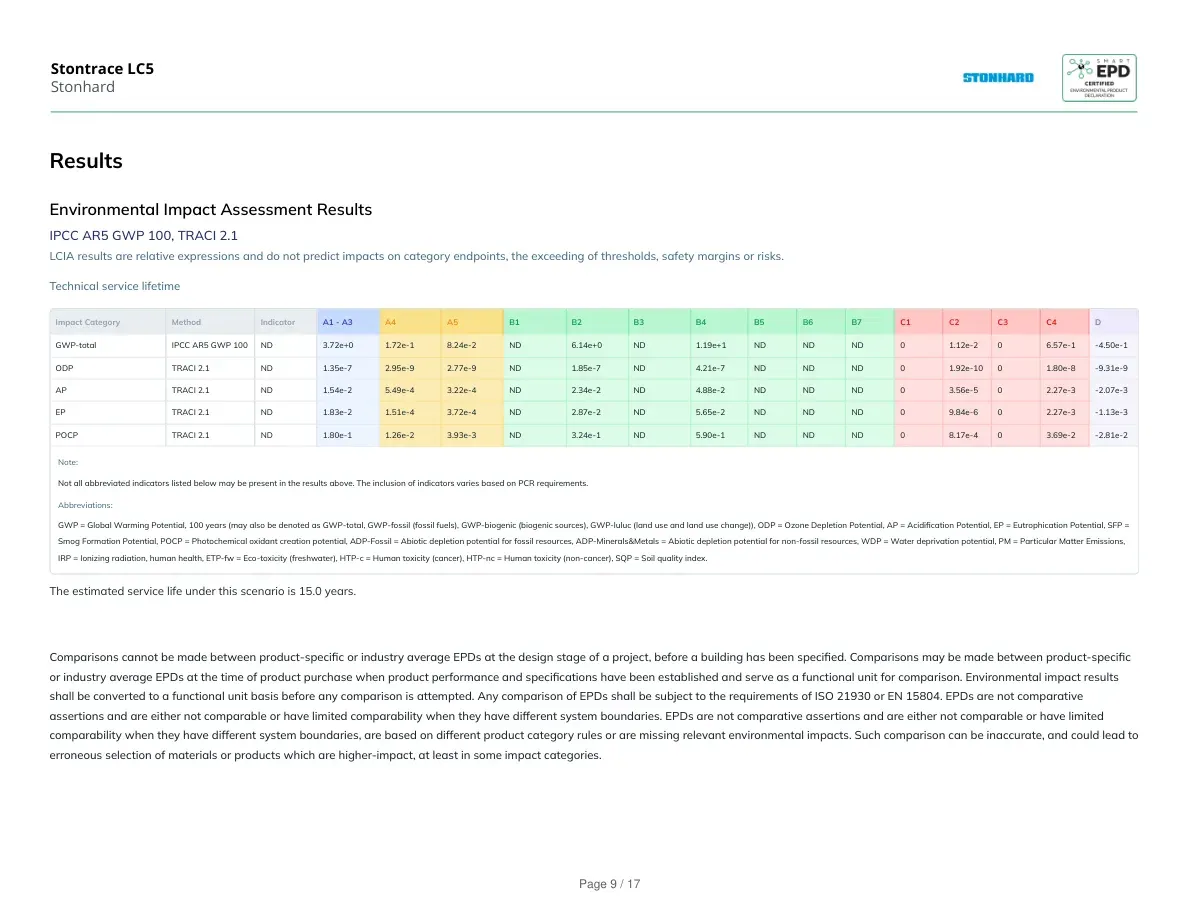
Technical service lifetimeImpact CategoryUnitMethodA1 - A3A4A5B1B2B3B4B5B6B7C1C2C3C4DGWP-totalkg CO2-eqIPCC AR5GWP 1003.71e+01.89e-19.63e-2ND6.14e+0ND1.20e+1NDNDND01.12e-206.57e-1-9.30e-2ODPkg CFC-11 eqTRACI 2.11.28e-73.25e-92.65e-9ND1.85e-7ND4.01e-7NDNDND01.92e-1001.80e-8-2.84e-9APkg SO2 eqTRACI 2.11.47e-26.04e-43.12e-4ND2.34e-2ND4.69e-2NDNDND03.56e-502.27e-3-2.01e-4EPkg N eqTRACI 2.11.82e-21.67e-43.72e-4ND2.87e-2ND5.62e-2NDNDND09.84e-602.27e-3-7.17e-5POCPkg O3 eqTRACI 2.11.75e-11.38e-23.96e-3ND3.24e-1ND5.79e-1NDNDND08.17e-403.69e-2-5.05e-3Note:Not all abbreviated indicators listed below may be present in the results above. The inclusion of indicators varies based on PCR requirements.Abbreviations:GWP = Global Warming Potential, 100 years (may also be denoted as GWP-total, GWP-fossil (fossil fuels), GWP-biogenic (biogenic sources), GWP-luluc (land use and land use change)), ODP = Ozone Depletion Potential, AP = Acidification Potential, EP = Eutrophication Potential, SFP =Smog Formation Potential, POCP = Photochemical oxidant creation potential, ADP-Fossil = Abiotic depletion potential for fossil resources, ADP-Minerals&Metals = Abiotic depletion potential for non-fossil resources, WDP = Water deprivation potential, PM = Particular Matter Emissions,IRP = Ionizing radiation, human health, ETP-fw = Eco-toxicity (freshwater), HTP-c = Human toxicity (cancer), HTP-nc = Human toxicity (non-cancer), SQP = Soil quality index.The estimated service life under this scenario is 15.0 years. Comparisons cannot be made between product-specific or industry average EPDs at the design stage of a project, before a building has been specified. Comparisons may be made between product-specificor industry average EPDs at the time of product purchase when product performance and specifications have been established and serve as a functional unit for comparison. Environmental impact resultsshall be converted to a functional unit basis before any comparison is attempted. Any comparison of EPDs shall be subject to the requirements of ISO 21930 or EN 15804. EPDs are not comparativeassertions and are either not comparable or have limited comparability when they have different system boundaries. EPDs are not comparative assertions and are either not comparable or have limitedcomparability when they have different system boundaries, are based on different product category rules or are missing relevant environmental impacts. Such comparison can be inaccurate, and could lead toerroneous selection of materials or products which are higher-impact, at least in some impact categories.Stontrace LC5StonhardPage 12 / 19
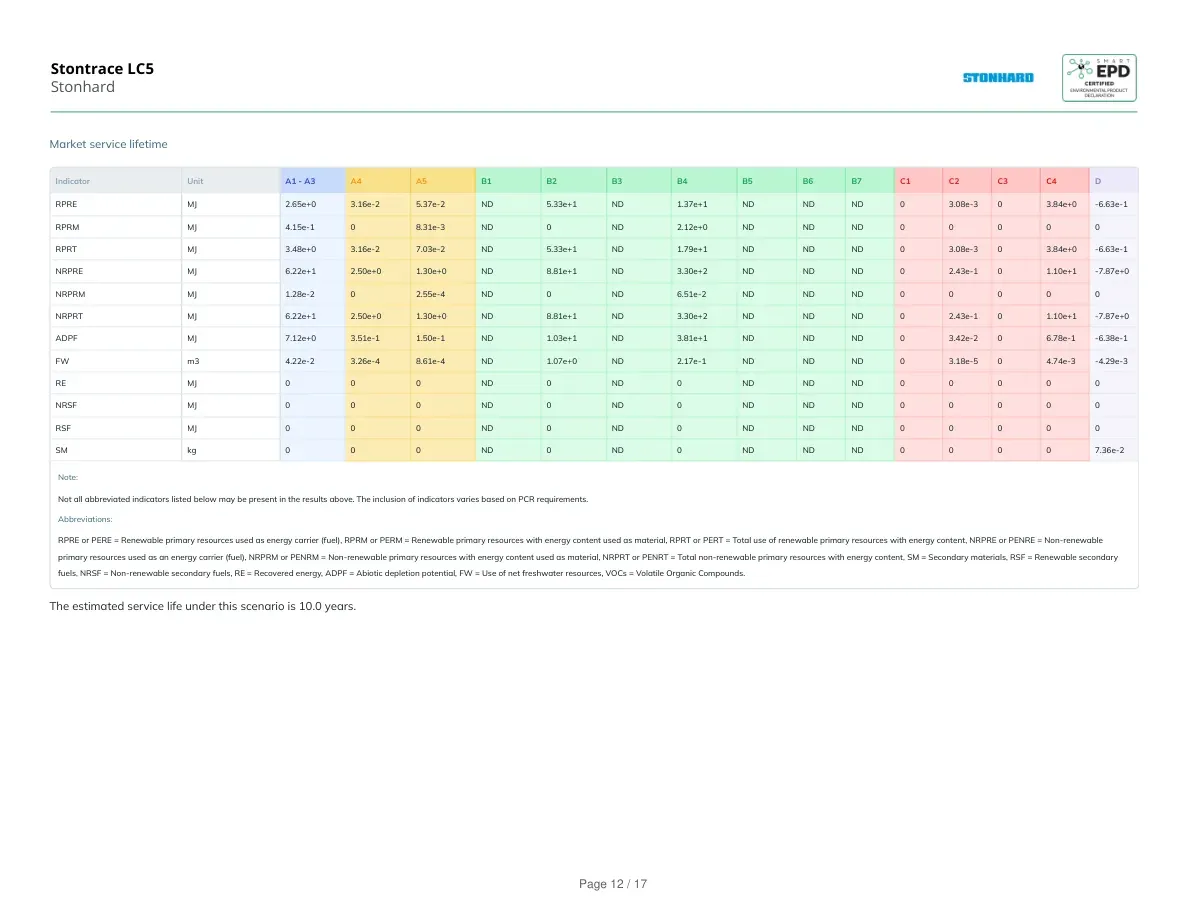
Resource Use Indicatorper 1 m2 of product of covered and protected flooring surface for a period of 60 years.Market service lifetimeIndicatorUnitA1 - A3A4A5B1B2B3B4B5B6B7C1C2C3C4DRPREMJ2.57e+03.48e-25.23e-2ND5.33e+1ND1.33e+1NDNDND03.08e-303.84e+0-4.14e-2RPRMMJ000ND0ND0NDNDND00000RPRTMJ2.57e+03.48e-25.23e-2ND5.33e+1ND1.33e+1NDNDND03.08e-303.84e+0-4.14e-2NRPREMJ6.58e+12.75e+01.38e+0ND8.81e+1ND3.50e+2NDNDND02.43e-101.10e+1-2.09e+0NRPRMMJ1.06e-102.13e-3ND0ND5.42e-1NDNDND00000NRPRTMJ6.60e+12.75e+01.39e+0ND8.81e+1ND3.51e+2NDNDND02.43e-101.10e+1-2.09e+0ADPFMJ7.74e+03.86e-11.64e-1ND1.03e+1ND4.14e+1NDNDND03.42e-206.78e-1-3.10e-1FWm34.13e-23.59e-48.60e-4ND1.07e+0ND2.13e-1NDNDND03.18e-504.74e-3-2.11e-4REMJ000ND0ND0NDNDND00000NRSFMJ000ND0ND0NDNDND00000RSFMJ000ND0ND0NDNDND00000SMkg000ND0ND0NDNDND00000Note:Not all abbreviated indicators listed below may be present in the results above. The inclusion of indicators varies based on PCR requirements.Abbreviations:RPRE or PERE = Renewable primary resources used as energy carrier (fuel), RPRM or PERM = Renewable primary resources with energy content used as material, RPRT or PERT = Total use of renewable primary resources with energy content, NRPRE or PENRE = Non-renewableprimary resources used as an energy carrier (fuel), NRPRM or PENRM = Non-renewable primary resources with energy content used as material, NRPRT or PENRT = Total non-renewable primary resources with energy content, SM = Secondary materials, RSF = Renewable secondaryfuels, NRSF = Non-renewable secondary fuels, RE = Recovered energy, ADPF = Abiotic depletion potential, FW = Use of net freshwater resources, VOCs = Volatile Organic Compounds.The estimated service life under this scenario is 10.0 years. Stontrace LC5StonhardPage 13 / 19
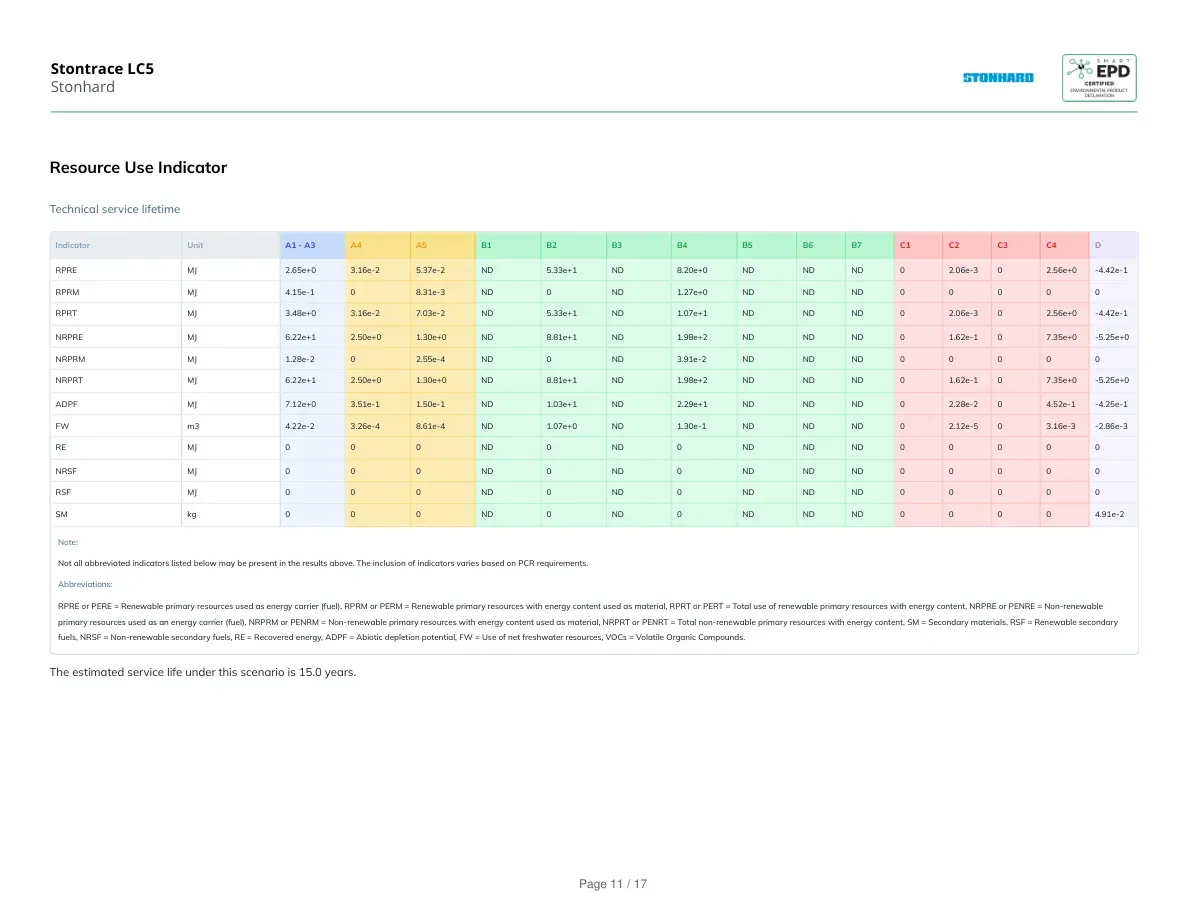
Technical service lifetimeIndicatorUnitA1 - A3A4A5B1B2B3B4B5B6B7C1C2C3C4DRPREMJ2.57e+03.48e-25.23e-2ND5.33e+1ND7.97e+0NDNDND02.06e-302.56e+0-2.76e-2RPRMMJ000ND0ND0NDNDND00000RPRTMJ2.57e+03.48e-25.23e-2ND5.33e+1ND7.97e+0NDNDND02.06e-302.56e+0-2.76e-2NRPREMJ6.58e+12.75e+01.38e+0ND8.81e+1ND2.10e+2NDNDND01.62e-107.35e+0-1.39e+0NRPRMMJ1.06e-102.13e-3ND0ND3.25e-1NDNDND00000NRPRTMJ6.60e+12.75e+01.39e+0ND8.81e+1ND2.10e+2NDNDND01.62e-107.35e+0-1.39e+0ADPFMJ7.74e+03.86e-11.64e-1ND1.03e+1ND2.49e+1NDNDND02.28e-204.52e-1-2.07e-1FWm34.13e-23.59e-48.60e-4ND1.07e+0ND1.28e-1NDNDND02.12e-503.16e-3-1.41e-4REMJ000ND0ND0NDNDND00000NRSFMJ000ND0ND0NDNDND00000RSFMJ000ND0ND0NDNDND00000SMkg000ND0ND0NDNDND00000Note:Not all abbreviated indicators listed below may be present in the results above. The inclusion of indicators varies based on PCR requirements.Abbreviations:RPRE or PERE = Renewable primary resources used as energy carrier (fuel), RPRM or PERM = Renewable primary resources with energy content used as material, RPRT or PERT = Total use of renewable primary resources with energy content, NRPRE or PENRE = Non-renewableprimary resources used as an energy carrier (fuel), NRPRM or PENRM = Non-renewable primary resources with energy content used as material, NRPRT or PENRT = Total non-renewable primary resources with energy content, SM = Secondary materials, RSF = Renewable secondaryfuels, NRSF = Non-renewable secondary fuels, RE = Recovered energy, ADPF = Abiotic depletion potential, FW = Use of net freshwater resources, VOCs = Volatile Organic Compounds.The estimated service life under this scenario is 15.0 years. Stontrace LC5StonhardPage 14 / 19
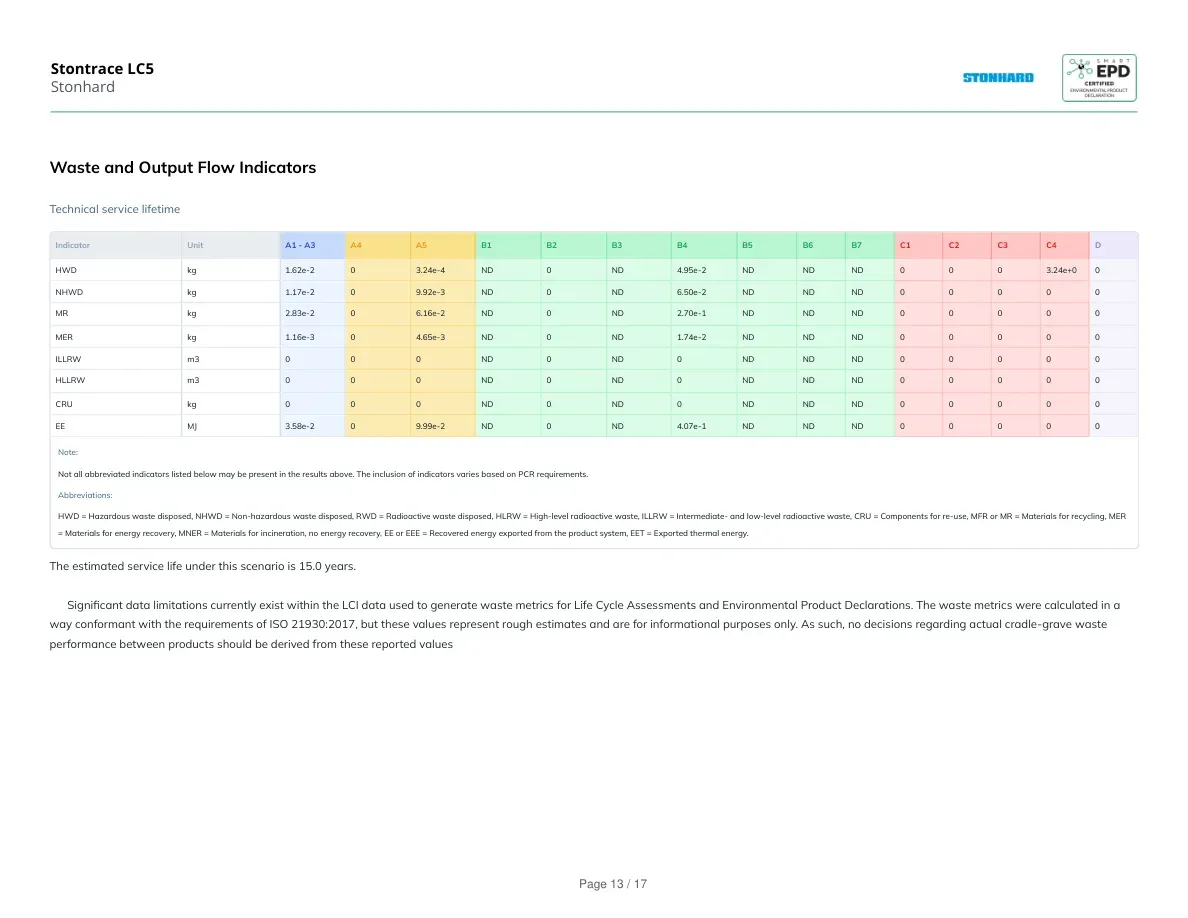
Waste and Output Flow Indicatorsper 1 m2 of product of covered and protected flooring surface for a period of 60 years.Market service lifetimeIndicatorUnitA1 - A3A4A5B1B2B3B4B5B6B7C1C2C3C4DHWDkg1.62e-203.24e-4ND0ND8.25e-2NDNDND0004.86e+00NHWDkg1.17e-203.27e-2ND0ND2.22e-1NDNDND00000MRkg2.83e-201.25e-1ND0ND7.68e-1NDNDND00000MERkg1.16e-307.51e-3ND0ND4.33e-2NDNDND00000ILLRWm3000ND0ND0NDNDND00000HLLRWm3000ND0ND0NDNDND00000CRUkg000ND0ND0NDNDND00000EEMJ3.58e-202.31e-1ND0ND1.33e+0NDNDND00000Note:Not all abbreviated indicators listed below may be present in the results above. The inclusion of indicators varies based on PCR requirements.Abbreviations:HWD = Hazardous waste disposed, NHWD = Non-hazardous waste disposed, RWD = Radioactive waste disposed, HLRW = High-level radioactive waste, ILLRW = Intermediate- and low-level radioactive waste, CRU = Components for re-use, MFR or MR = Materials for recycling, MER= Materials for energy recovery, MNER = Materials for incineration, no energy recovery, EE or EEE = Recovered energy exported from the product system, EET = Exported thermal energy.The estimated service life under this scenario is 10.0 years. Significant data limitations currently exist within the LCI data used to generate waste metrics for Life Cycle Assessments and Environmental Product Declarations. The waste metrics were calculated in a way conformant with the requirements of ISO 21930:2017, but these values represent rough estimates and are for informational purposes only. As such, no decisions regarding actual cradle-grave waste performance between products should be derived from these reported valuesStontrace LC5StonhardPage 15 / 19
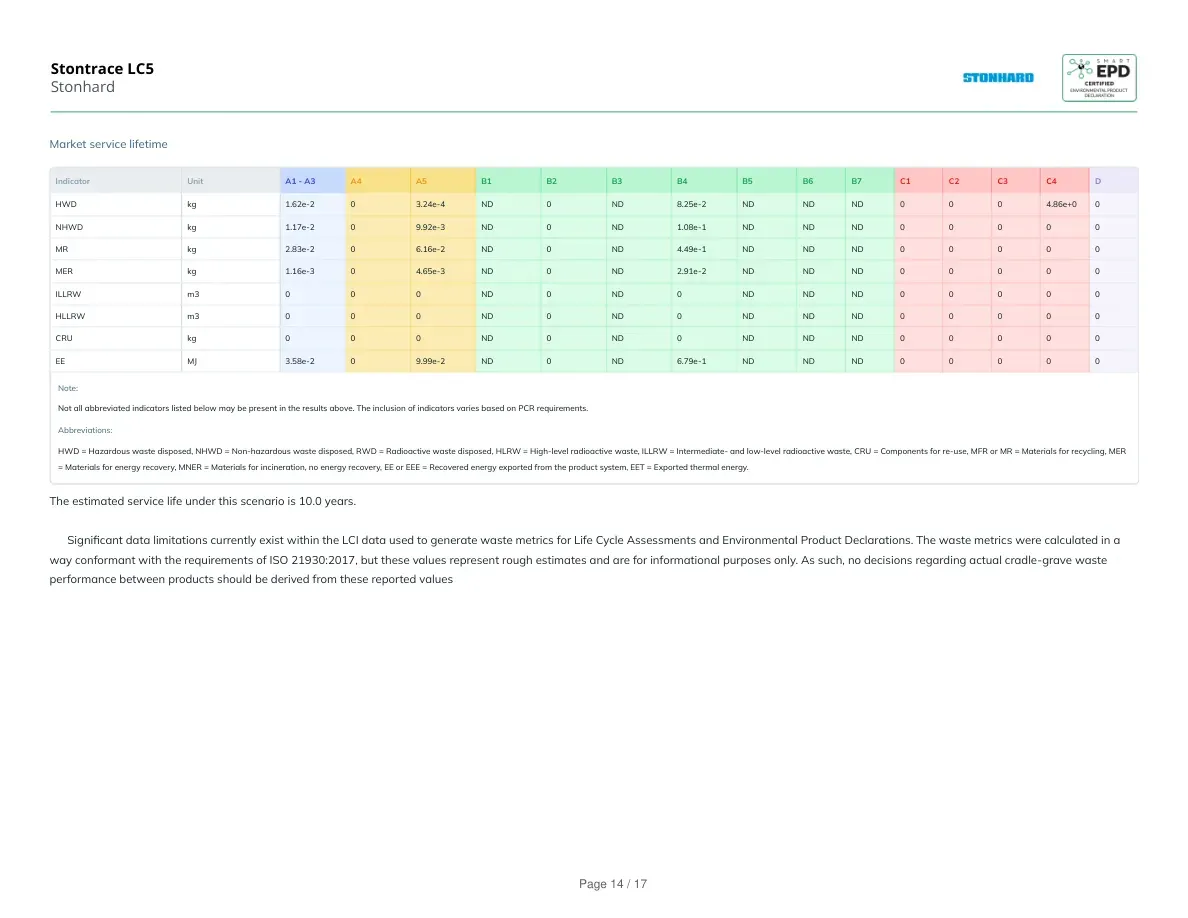
Technical service lifetimeIndicatorUnitA1 - A3A4A5B1B2B3B4B5B6B7C1C2C3C4DHWDkg1.62e-203.24e-4ND0ND4.95e-2NDNDND0003.24e+00NHWDkg1.17e-203.27e-2ND0ND1.33e-1NDNDND00000MRkg2.83e-201.25e-1ND0ND4.61e-1NDNDND00000MERkg1.16e-307.51e-3ND0ND2.60e-2NDNDND00000ILLRWm3000ND0ND0NDNDND00000HLLRWm3000ND0ND0NDNDND00000CRUkg000ND0ND0NDNDND00000EEMJ3.58e-202.31e-1ND0ND8.01e-1NDNDND00000Note:Not all abbreviated indicators listed below may be present in the results above. The inclusion of indicators varies based on PCR requirements.Abbreviations:HWD = Hazardous waste disposed, NHWD = Non-hazardous waste disposed, RWD = Radioactive waste disposed, HLRW = High-level radioactive waste, ILLRW = Intermediate- and low-level radioactive waste, CRU = Components for re-use, MFR or MR = Materials for recycling, MER= Materials for energy recovery, MNER = Materials for incineration, no energy recovery, EE or EEE = Recovered energy exported from the product system, EET = Exported thermal energy.The estimated service life under this scenario is 15.0 years. Significant data limitations currently exist within the LCI data used to generate waste metrics for Life Cycle Assessments and Environmental Product Declarations. The waste metrics were calculated in a way conformant with the requirements of ISO 21930:2017, but these values represent rough estimates and are for informational purposes only. As such, no decisions regarding actual cradle-grave waste performance between products should be derived from these reported valuesStontrace LC5StonhardPage 16 / 19
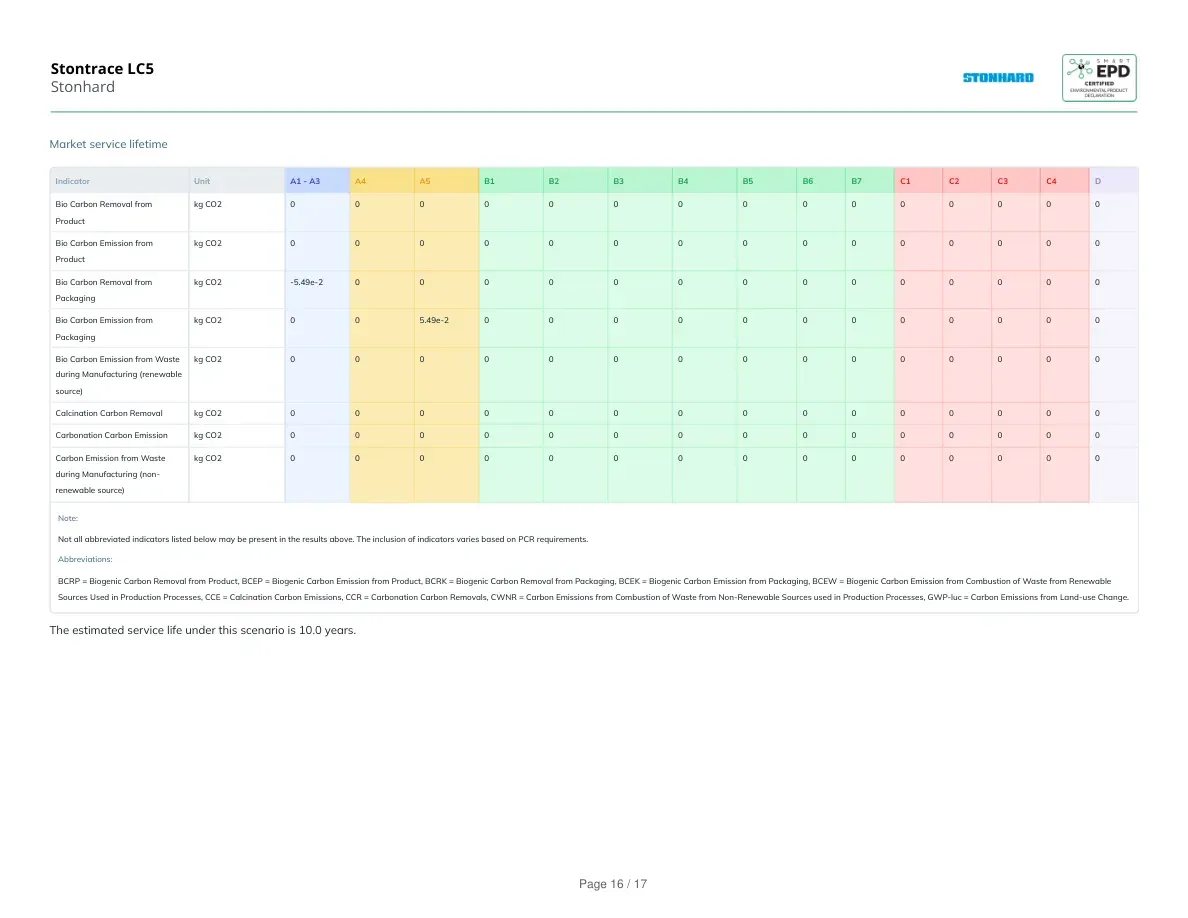
Carbon Emissions and Removalsper 1 m2 of product of covered and protected flooring surface for a period of 60 years.Market service lifetimeIndicatorUnitA1 - A3A4A5B1B2B3B4B5B6B7C1C2C3C4DBio Carbon Removal fromProductkg CO2000000000000000Bio Carbon Emission fromProductkg CO2000000000000000Bio Carbon Removal fromPackagingkg CO2000000000000000Bio Carbon Emission fromPackagingkg CO2000000000000000Bio Carbon Emission from Wasteduring Manufacturing (renewablesource)kg CO2000000000000000Calcination Carbon Removalkg CO2000000000000000Carbonation Carbon Emissionkg CO2000000000000000Carbon Emission from Wasteduring Manufacturing (non-renewable source)kg CO2000000000000000Note:Not all abbreviated indicators listed below may be present in the results above. The inclusion of indicators varies based on PCR requirements.Abbreviations:BCRP = Biogenic Carbon Removal from Product, BCEP = Biogenic Carbon Emission from Product, BCRK = Biogenic Carbon Removal from Packaging, BCEK = Biogenic Carbon Emission from Packaging, BCEW = Biogenic Carbon Emission from Combustion of Waste from RenewableSources Used in Production Processes, CCE = Calcination Carbon Emissions, CCR = Carbonation Carbon Removals, CWNR = Carbon Emissions from Combustion of Waste from Non-Renewable Sources used in Production Processes, GWP-luc = Carbon Emissions from Land-use Change.The estimated service life under this scenario is 10.0 years. Stontrace LC5StonhardPage 17 / 19
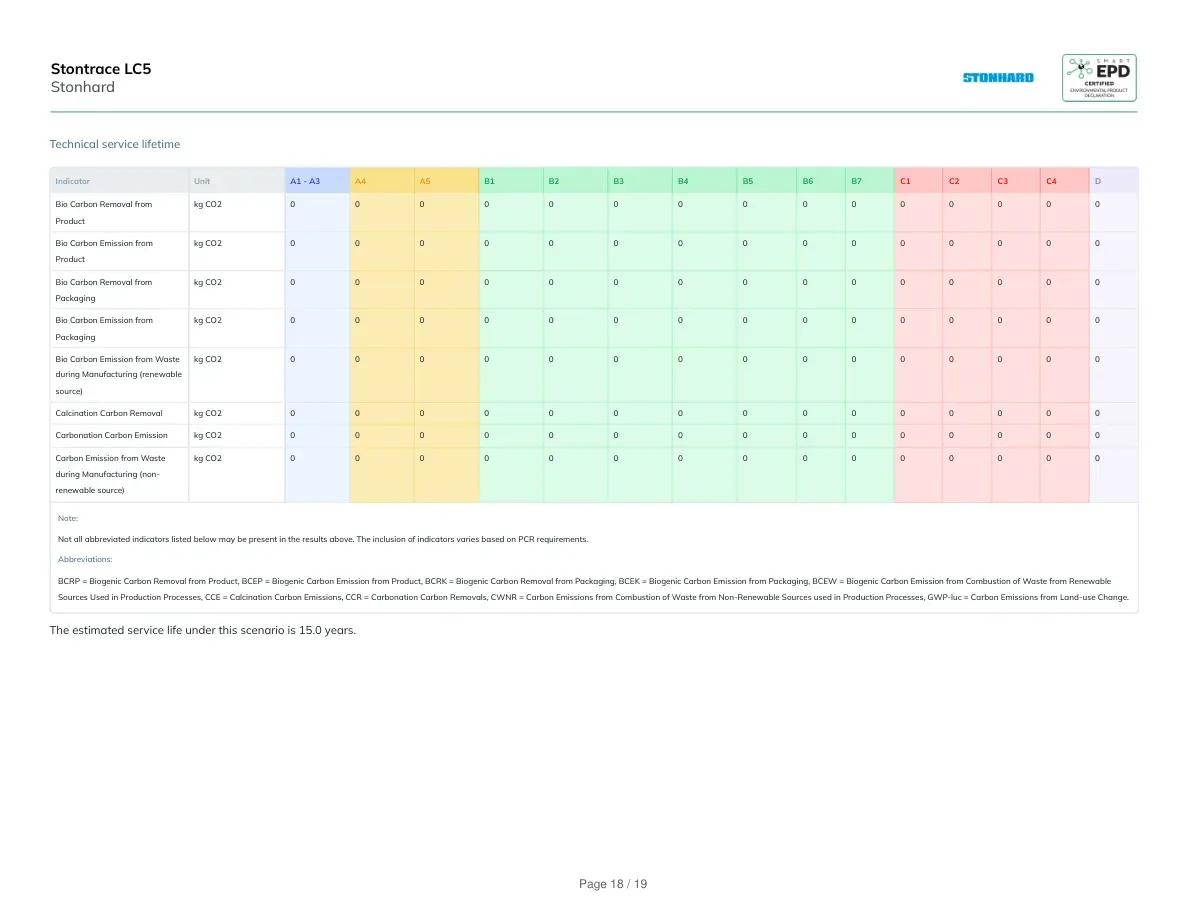
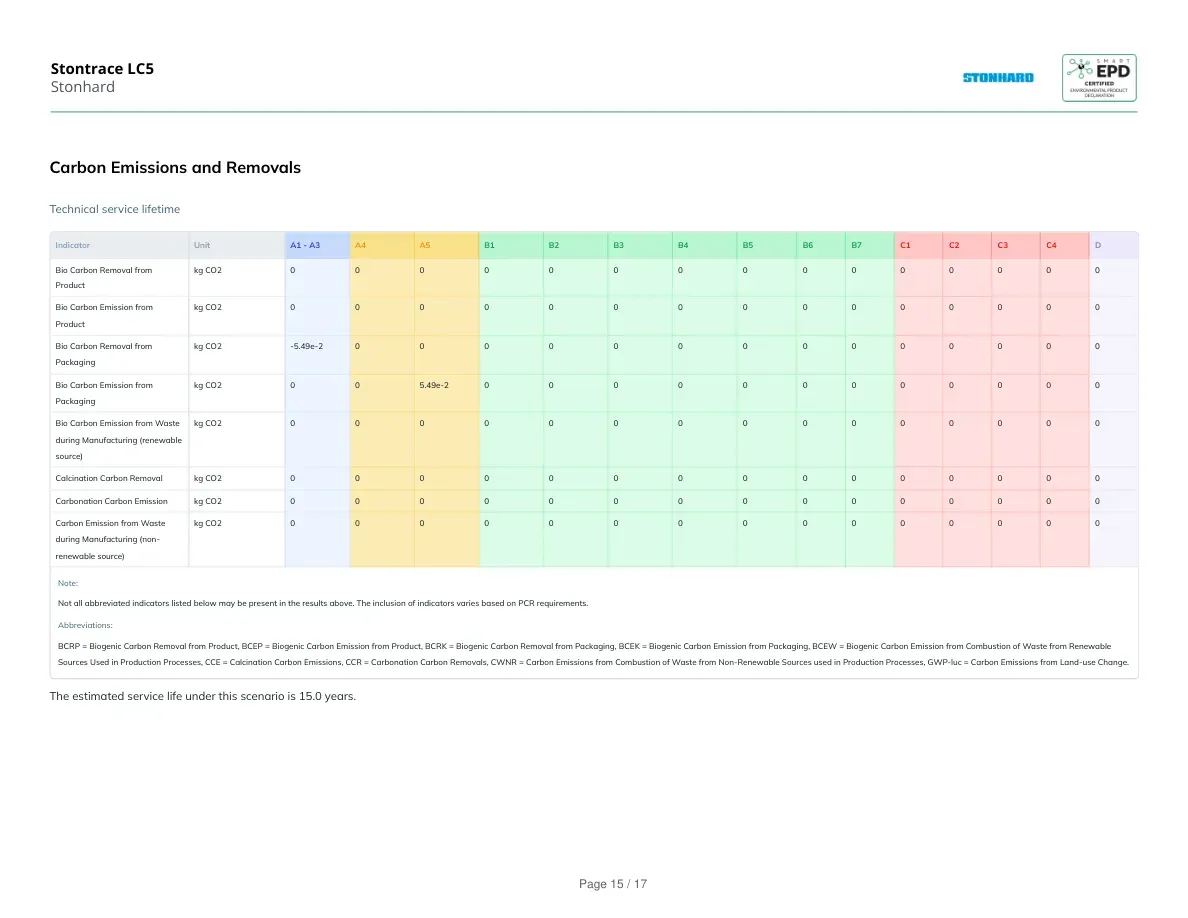
Technical service lifetimeIndicatorUnitA1 - A3A4A5B1B2B3B4B5B6B7C1C2C3C4DBio Carbon Removal fromProductkg CO2000000000000000Bio Carbon Emission fromProductkg CO2000000000000000Bio Carbon Removal fromPackagingkg CO2000000000000000Bio Carbon Emission fromPackagingkg CO2000000000000000Bio Carbon Emission from Wasteduring Manufacturing (renewablesource)kg CO2000000000000000Calcination Carbon Removalkg CO2000000000000000Carbonation Carbon Emissionkg CO2000000000000000Carbon Emission from Wasteduring Manufacturing (non-renewable source)kg CO2000000000000000Note:Not all abbreviated indicators listed below may be present in the results above. The inclusion of indicators varies based on PCR requirements.Abbreviations:BCRP = Biogenic Carbon Removal from Product, BCEP = Biogenic Carbon Emission from Product, BCRK = Biogenic Carbon Removal from Packaging, BCEK = Biogenic Carbon Emission from Packaging, BCEW = Biogenic Carbon Emission from Combustion of Waste from RenewableSources Used in Production Processes, CCE = Calcination Carbon Emissions, CCR = Carbonation Carbon Removals, CWNR = Carbon Emissions from Combustion of Waste from Non-Renewable Sources used in Production Processes, GWP-luc = Carbon Emissions from Land-use Change.The estimated service life under this scenario is 15.0 years. Stontrace LC5StonhardPage 18 / 19
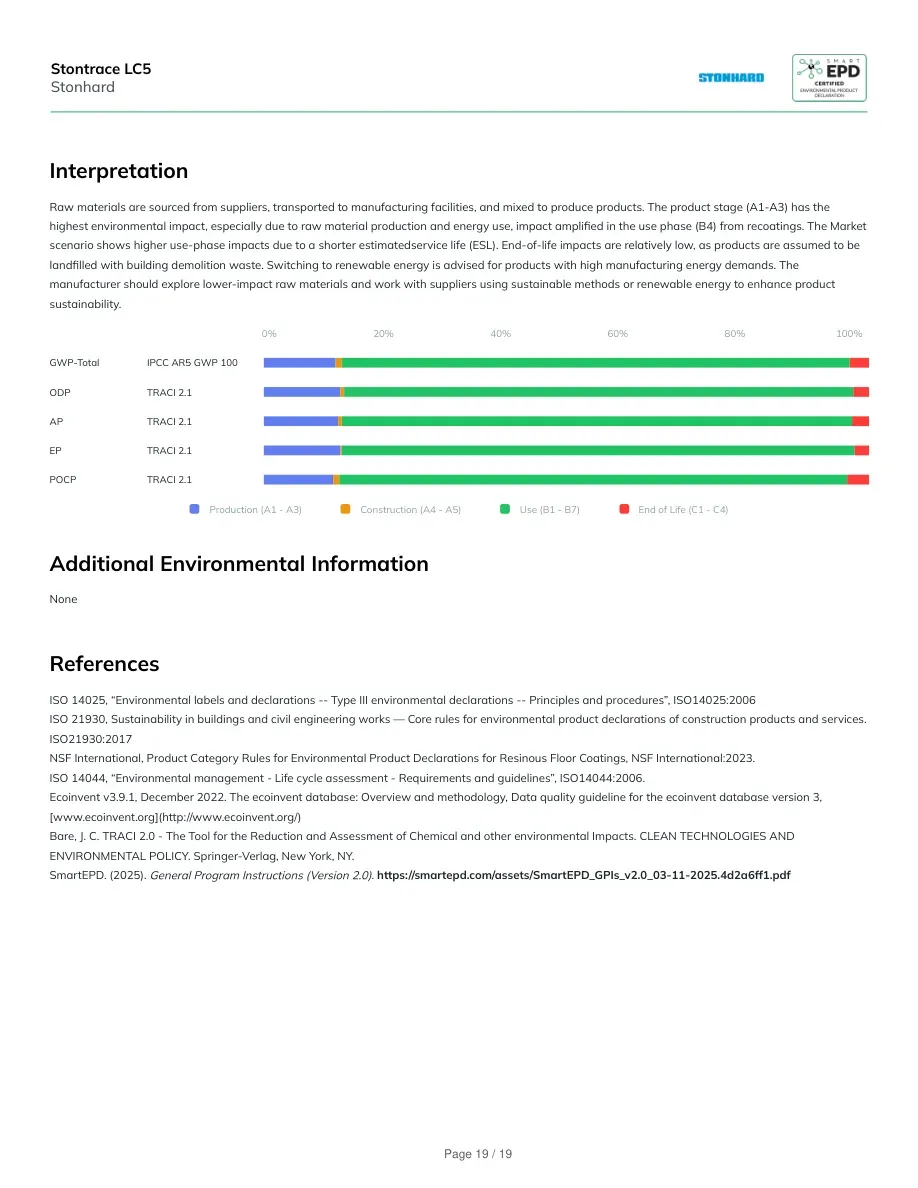
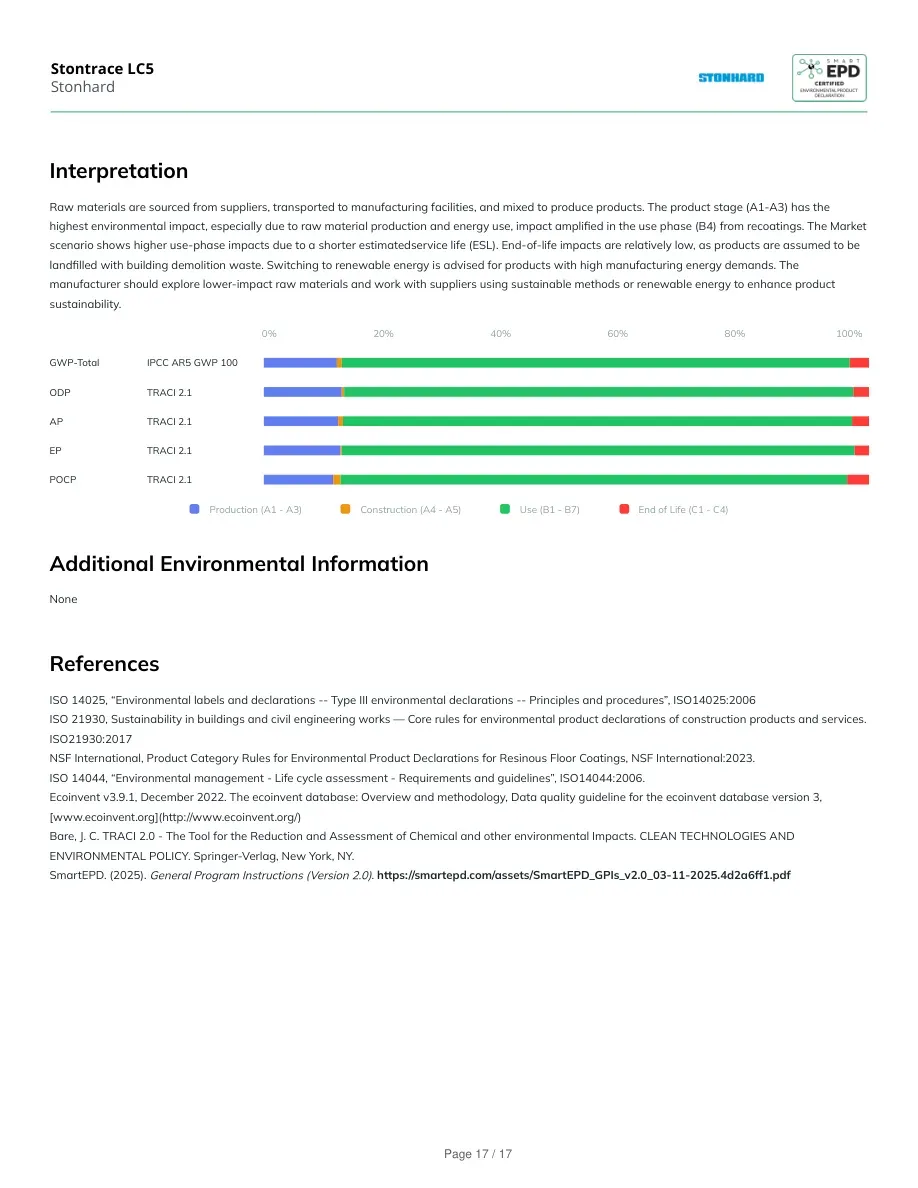
InterpretationRaw materials are sourced from suppliers, transported to manufacturing facilities, and mixed to produce products. The product stage (A1-A3) has thehighest environmental impact, especially due to raw material production and energy use, impact amplified in the use phase (B4) from recoatings. The Marketscenario shows higher use-phase impacts due to a shorter estimatedservice life (ESL). End-of-life impacts are relatively low, as products are assumed to belandfilled with building demolition waste. Switching to renewable energy is advised for products with high manufacturing energy demands. Themanufacturer should explore lower-impact raw materials and work with suppliers using sustainable methods or renewable energy to enhance productsustainability.0%20%40%60%80%100%GWP-TotalIPCC AR5 GWP 100ODPTRACI 2.1APTRACI 2.1EPTRACI 2.1POCPTRACI 2.1Production (A1 - A3)Construction (A4 - A5)Use (B1 - B7)End of Life (C1 - C4)Additional Environmental InformationNoneReferencesISO 14025, “Environmental labels and declarations -- Type III environmental declarations -- Principles and procedures”, ISO14025:2006ISO 21930, Sustainability in buildings and civil engineering works — Core rules for environmental product declarations of construction products and services.ISO21930:2017NSF International, Product Category Rules for Environmental Product Declarations for Resinous Floor Coatings, NSF International:2023.ISO 14044, “Environmental management - Life cycle assessment - Requirements and guidelines”, ISO14044:2006.Ecoinvent v3.9.1, December 2022. The ecoinvent database: Overview and methodology, Data quality guideline for the ecoinvent database version 3,[www.ecoinvent.org](http://www.ecoinvent.org/)Bare, J. C. TRACI 2.0 - The Tool for the Reduction and Assessment of Chemical and other environmental Impacts. CLEAN TECHNOLOGIES ANDENVIRONMENTAL POLICY. Springer-Verlag, New York, NY.SmartEPD. (2025). General Program Instructions (Version 2.0). https://smartepd.com/assets/SmartEPD_GPIs_v2.0_03-11-2025.4d2a6ff1.pdfStontrace LC5StonhardPage 19 / 19
